JN0-650 Practice Questions: Test Your Routing and Switching Skills
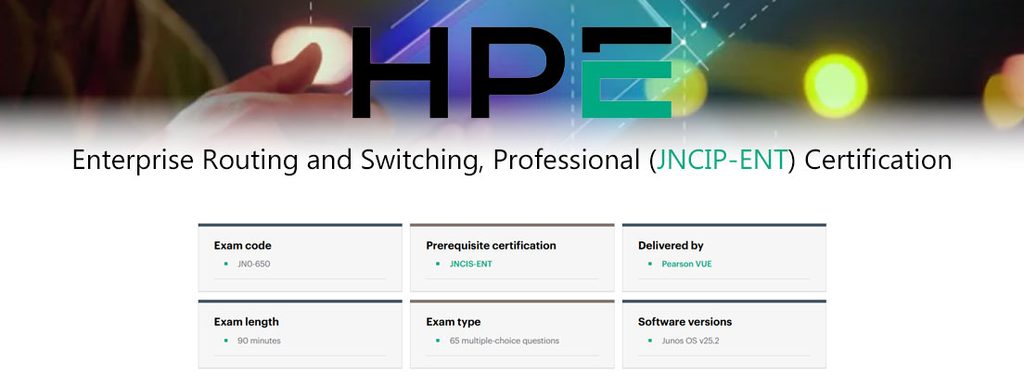
To prepare for the Juniper Networks Certified Professional – Enterprise Routing and Switching-Professional (JNCIP-ENT) certification, you need a deep understanding of how Junos OS handles routing decisions, switching behavior, traffic classification, authentication, and EVPN services, as well as how these functions work together in real-world network scenarios.
These JN0-650 practice questions are drawn from the original Leads4Pass exam dumps https://www.leads4pass.com/jn0-650.html and cover several important exam topics. Each question includes an answer and a technical explanation to help you review the reasoning behind it.
JN0-650 Exam Overview
| Exam detail | Information |
| Certification | JNCIP-ENT |
| Exam code | JN0-650 |
| Prerequisite | JNCIS-ENT |
| Exam duration | 90 minutes |
| Question format | 65 multiple-choice questions |
| Exam delivery | Pearson VUE |
| Junos OS version | v25.2 |
What Does the JN0-650 Exam Cover?
The exam evaluates professional-level knowledge of enterprise routing and switching, including the configuration, operation, and troubleshooting of Juniper networks.
Key areas include:
- Routing protocols: OSPF, BGP, routing policies, and route selection.
- Layer 2 switching: VLANs, spanning-tree protocols, MVRP, and access control.
- Class of service (CoS): Traffic classification, forwarding classes, packet loss priority, scheduling, and rewrite rules.
- EVPN and VXLAN: Route types, overlay connectivity, and multihoming.
- Multicast: PIM operation, source-specific multicast, and receiver membership.
- IP telephony and authentication: PoE, LLDP-MED, voice VLANs, 802.1X, and MAC RADIUS.
A useful preparation strategy is to connect each topic to a troubleshooting scenario. Knowing what a feature does is important; knowing which setting or protocol behavior explains a particular network outcome is equally valuable.
JN0-650 Practice Questions With Answers and Explanations
The following questions are selected from the Leads4Pass exam dumps. Try answering each question before reading the explanation.
Question 1: 802.1X Server-Failure Fallback
Your organization uses 802.1X with a RADIUS server. If the RADIUS server stops responding, you want the fallback action to continue permitting access for devices that currently have authorization while denying new access attempts.
Which fallback action provides this capability?
A. deny
B. vlan-name
C. permit
D. use-cache
Answer: D. use-cache
Explanation
The use-cache fallback action allows the switch to use cached authentication information when the RADIUS server becomes unavailable. This supports continued access for devices with previously established authorization while avoiding blanket permission for new access attempts.
The distinction between cached authorization and unrestricted fallback access is important when designing resilient access-control policies.
Review point: Understand how Junos OS handles server-failure fallback and how it differs from actions such as permit, deny, and VLAN-based fallback.
Question 2: EVPN Pure Type-5 Routes
Which two statements are correct about EVPN Pure Type-5 routes? Choose two.
A. Pure Type-5 routes rely on Type-7 sync routes.
B. Pure Type-5 routes require an overlay next hop.
C. Pure Type-5 routes are also known as IP-VRF-to-IP-VRF.
D. Pure Type-5 routes are advertised with the MAC extended community.
Answers: B and C
Explanation
Pure Type-5 routing uses the IP-VRF-to-IP-VRF model to advertise IP prefixes between EVPN-connected networks. In this model, the Type-5 route carries a router MAC extended community that provides the information needed for next-hop reachability.
A pure Type-5 route does not require an overlay next hop or a supporting Type-2 route for recursive next-hop resolution. This distinguishes it from the standard Type-5 forwarding model.
Review point: Compare standard and pure Type-5 routes, including their next-hop requirements, route resolution, and use in Layer 3 data-center interconnects.
Reference: Juniper’s explanation of EVPN Pure Type-5 routes.
Question 3: DSCP Rewrite Rules
An IP packet leaves through an interface with a DSCP rewrite rule. What should determine the outgoing DSCP value?
A. The packet’s internal forwarding class and packet loss priority
B. The remote peer’s scheduler map and Ethernet segment identifier
C. The ingress interface’s power budget and link speed
D. The packet’s egress queue depth without its internal treatment
Answer: A. The packet’s internal forwarding class and packet loss priority
Explanation
Junos OS uses internal CoS treatment to classify traffic and apply the appropriate forwarding behavior. A DSCP rewrite rule maps that internal treatment to the outgoing DSCP value.
Forwarding class and packet loss priority (PLP) are therefore relevant to the rewrite decision. The egress queue’s depth alone does not determine the DSCP value, and unrelated settings such as PoE power budgets have no role in this mapping.
Review point: Trace the CoS processing path from ingress classification through forwarding-class assignment and queue scheduling to egress rewriting.
Question 4: Behavior Aggregate Classifiers
Incoming packets carry trusted DSCP values that already represent the desired service treatment. Which classifier should map those code points to forwarding class and packet loss priority?
A. A behavior aggregate classifier
B. A multifield classifier
C. A scheduler map
D. An egress rewrite rule
Answer: A. A behavior aggregate classifier
Explanation
A behavior aggregate (BA) classifier classifies traffic using a packet’s existing CoS marking, such as DSCP in an IP header. It maps the marking to the internal forwarding class and packet loss priority.
A multifield classifier instead evaluates selected packet-header fields. A scheduler map associates forwarding classes with scheduling behavior, while a rewrite rule determines how internal treatment is represented in outgoing packet markings.
Review point: Be able to distinguish classification, scheduling, and rewriting. They are connected parts of CoS, but they perform different jobs.
Question 5: Class of Service Across an MPLS Hop
Traffic crosses an MPLS hop. Which field in the top label carries the class-of-service marking used on that hop?
A. The MPLS traffic-class field
B. The IEEE 802.1p field in an Ethernet VLAN tag
C. The IP DSCP field carried inside the MPLS payload
D. The VXLAN VNI carried in an outer UDP payload
Answer: A. The MPLS traffic-class field
Explanation
The MPLS traffic-class field carries the marking used for traffic treatment across an MPLS hop. It is part of the MPLS label and can be used to support class-of-service handling within the MPLS network.
The IEEE 802.1p field belongs to an Ethernet VLAN tag. DSCP is an IP-header field, and a VXLAN Network Identifier identifies a VXLAN segment rather than serving as the MPLS CoS marking.
Review point: Know where CoS markings reside in Ethernet, IP, and MPLS headers, and how Junos OS maps between these fields.
Question 6: Multiple Authentication Methods
One access interface serves both 802.1X-capable endpoints and devices that cannot act as supplicants. Which method policy is sound?
A. Require every endpoint to complete 802.1X, MAC RADIUS, and captive portal authentication.
B. Send every explicit 802.1X rejection to an unrestricted server-failure VLAN.
C. Run only MAC RADIUS so every endpoint uses the same identity strength.
D. Prefer 802.1X; use explicit alternatives only for eligible endpoints.
Answer: D. Prefer 802.1X; use explicit alternatives only for eligible endpoints.
Explanation
An access network may need to support different endpoint capabilities. Devices that support 802.1X can use that method, while eligible devices that cannot act as supplicants may require another supported authentication method.
The authentication policy should define which methods apply to which endpoints and how fallback behavior is handled. Requiring every device to complete every method is not a practical policy, and an explicit authentication rejection should not automatically be treated as a server outage.
Review point: Review 802.1X, MAC RADIUS, captive portal, guest VLANs, server-failure fallback, and the behavior of multiple authentication methods on Juniper switches.
Question 7: OSPF Maintenance Using the Overload Bit
You need to perform maintenance on one of your OSPF routers. You do not want the other OSPF routers on the network to forward traffic to this router during the maintenance window.
Which OSPF configuration parameter would you implement?
A. traffic-engineering
B. overload
C. preference
D. spf-options
Answer: B. overload
Explanation
The OSPF overload bit signals that a router should not be used as a transit router for traffic. Other routers can take this signal into account when calculating paths, helping them avoid selecting the maintenance router as a transit point.
This is useful when a router remains active in the routing domain but should not carry transit traffic while maintenance is underway.
Review point: Understand the purpose of the OSPF overload bit, when to use it, and how it affects route selection compared with changing route preferences or SPF settings.
Question 8: EVPN Route Types for Broadcast Traffic
Remote provider edges need membership and tunnel information to deliver broadcast, unknown-unicast, and multicast traffic for an EVPN broadcast domain. Which route supplies it?
A. Route Type 3
B. Route Type 2
C. Route Type 4
D. Route Type 5
Answer: A. Route Type 3
Explanation
EVPN Type-3 routes are inclusive multicast Ethernet-tag routes. They help establish the information required to deliver broadcast, unknown-unicast, and multicast (BUM) traffic between provider-edge devices participating in an EVPN broadcast domain.
Other EVPN route types have different roles. Type 2 advertises MAC and IP reachability, Type 4 supports Ethernet-segment discovery for multihoming, and Type 5 advertises IP prefixes.
Review point: Learn the purpose of each major EVPN route type and connect it to the network information it distributes.
Reference: Juniper EVPN route-type documentation.
Question 9: EVPN Type-5 Routes Between Data Centers
Layer 2 connectivity does not extend between two data centers, and each data center uses a distinct IP subnet. Which EVPN route type advertises IP prefixes between the data centers?
A. Type 1
B. Type 2
C. Type 4
D. Type 5
Answer: D. Type 5
Explanation
EVPN Type-5 routes advertise IP prefixes and support Layer 3 connectivity between data centers when the Layer 2 domain does not extend across locations. Each data center can retain its own IP subnet while exchanging the prefix reachability needed for inter-data-center communication.
Type 1 and Type 4 are associated with EVPN Ethernet-segment functions, while Type 2 advertises MAC and IP information for endpoints.
Review point: Understand when to use Type-2 host reachability versus Type-5 IP-prefix reachability in EVPN-VXLAN designs.
Reference: Juniper’s EVPN Pure Type-5 overview.
Question 10: Multiple choice
Click the Exhibit button.
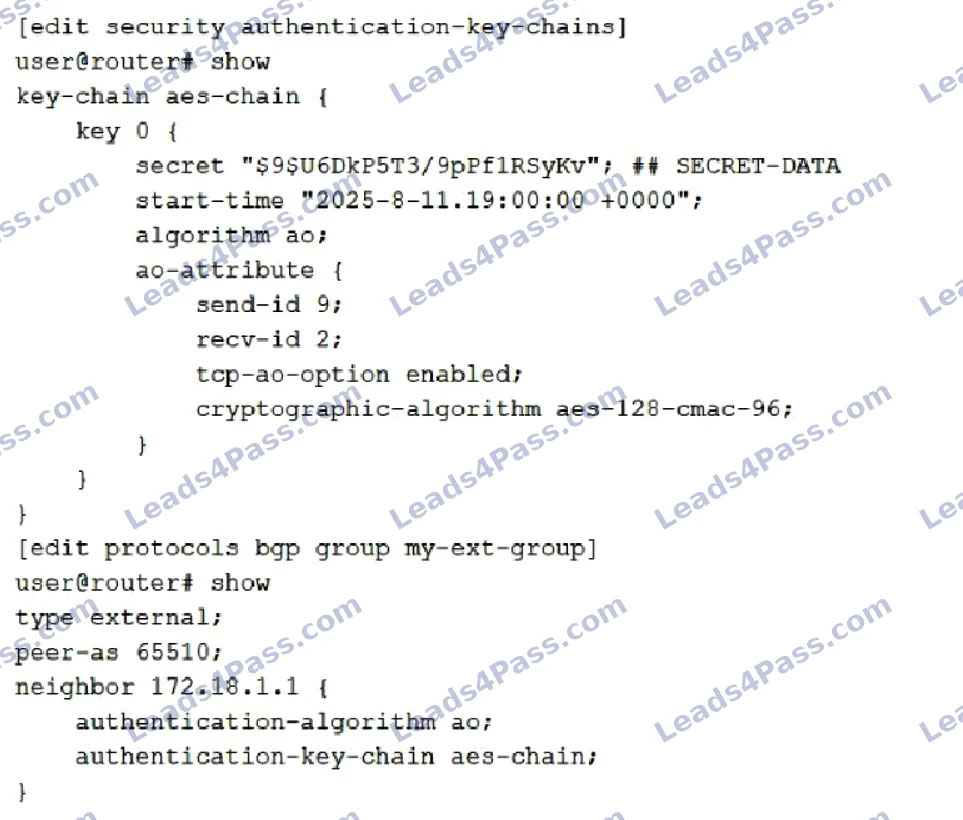
You are asked to configure BGP authentication on your network using TCP-AO, similar to what is shown in the exhibit.
In this scenario, which two statements are true? (Choose two.)
A.Neighbor 172.18.1.1 will use recv-id 2 to verify the hash.Correct answer
B.BGP is using AES for authentication.Correct answer
C.Neighbor 172.18.1.1 will use send-id 9 to verify the hash.
D.BGP is using MD5 for authentication.
Answer: A, B
Question 11:Single choice
Click the Exhibit button.
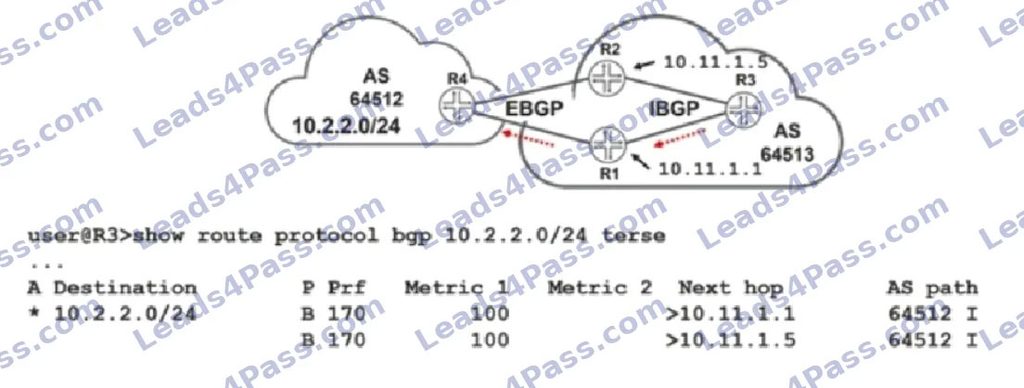
Referring to the exhibit, you want to change the exit point from R1 to R2 to reach 10.2.2.0/24.
Which BGP attribute would you need to manipulate on R3 to achieve this result?
A.local preference
B.AS path
C.origin
D.MED
Answer: A
Question 12:Multiple choice
Click the Exhibit button.
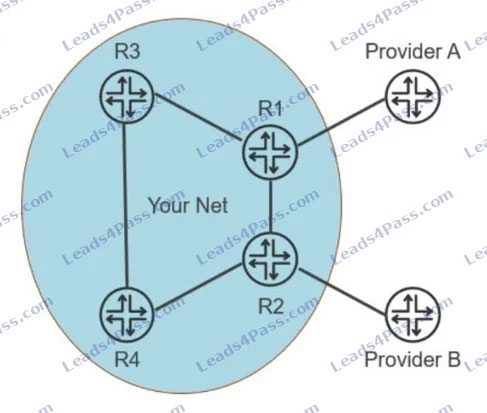
Your network receives the full Internet BGP routing table from two different ISPs. You want your local routers to use Provider A to forward all Internet traffic as long as Provider A is available.
Referring to the exhibit, which two actions would satisfy this requirement? (Choose two.)
A.Use a routing policy to set the local preference attribute value higher for the routes that are learned by R1.
B.Use a routing policy to set the local preference attribute value higher for the routes that are learned by R2.
C.Use a routing policy to set the local preference attribute value lower for the routes that are learned by R2.
D.Use a routing policy to set the local preference attribute value lower for the routes that are learned by R1.
Answer: A, C
…
How to Interpret Your Practice Results
Your score is useful, but the pattern of your answers can be even more valuable. Review each incorrect answer and identify the specific concept or decision that caused the problem.
| Result pattern | What to review next |
| You confuse similar routing attributes or route types | Compare their purpose, scope, and effect on forwarding decisions. |
| You recognize a feature but miss the scenario | Practice identifying the requirement before selecting a configuration or protocol behavior. |
| You confuse CoS components | Review classification, forwarding classes, PLP, schedulers, and rewrite rules as one processing path. |
| You miss authentication questions | Compare the purpose and behavior of each authentication method and fallback action. |
| You answer EVPN questions inconsistently | Build a route-type reference sheet covering Type 1, 2, 3, 4, and 5. |
For each missed question, write down three things: the requirement in the scenario, the feature that addresses it, and the reason the other options do not fit. This turns practice into a targeted review plan.
What Should You Study After These Questions?
Use your results to prioritize the next round of preparation.
1. Routing and BGP
Review OSPF behavior, BGP path selection, routing policies, and how attributes influence route choice. Practice interpreting the scenario before deciding which attribute or policy needs to change.
2. Switching and access control
Focus on spanning-tree variants, VLAN registration, private VLANs, 802.1X, MAC RADIUS, and server-failure behavior. Pay attention to what a feature changes on an interface and how that affects endpoint connectivity.
3. Class of service
Follow a packet through classification, forwarding-class assignment, PLP handling, scheduling, and rewrite processing. Understanding the relationships between these stages makes configuration and troubleshooting questions easier to reason through.
4. EVPN and VXLAN
Learn the function of each EVPN route type, the difference between MAC/IP and IP-prefix advertisements, and how control-plane information supports forwarding between network segments.
5. Multicast and IP telephony
Review PIM sparse mode, source-specific multicast, IGMP, PoE, LLDP-MED, and voice VLAN operation. These topics test whether you can match a network requirement to the feature that provides it.
Where to Find More JN0-650 Practice Questions
Continue with the Leads4Pass JN0-650 practice questions to work through more routing, switching, CoS, authentication, multicast, and EVPN scenarios.
As you progress, revisit the questions you missed and explain the correct answer in your own words. Being able to describe why a solution fits the stated network requirement is a strong sign that you understand the underlying concept.
You can also review the JN0-650 exam preparation page (https://www.leads4pass.com/jn0-650.html) for additional study information.
Frequently Asked Questions
How long is the JN0-650 exam?
Juniper lists the JN0-650 exam duration as 90 minutes, with 65 multiple-choice questions. Check the official certification page before scheduling in case exam details change.
What certification is required before taking JN0-650?
The listed prerequisite is the Juniper Networks Certified Specialist Enterprise Routing and Switching (JNCIS-ENT) certification.
Which topics deserve particular attention?
Routing protocols, BGP, Layer 2 switching and access control, CoS, EVPN, and IP telephony are all included in the published exam objectives. Use your practice results to determine which areas need the most review.
How should I review a missed practice question?
Identify the requirement in the scenario, review the feature involved, and explain why the correct answer meets that requirement. Then compare the distractors to understand which detail makes them unsuitable.
Are practice questions useful for technical review?
Yes. Scenario-based questions help you test how well you can apply networking concepts to configuration and troubleshooting decisions. Reviewing the explanations and following up on weak areas helps turn a practice result into a focused study plan.
Final Takeaway
The JN0-650 exam tests how well you understand enterprise routing and switching behavior in Juniper environments. A productive preparation routine combines focused study of the official objectives with practice questions, careful answer review, and targeted work on weak areas.
Start with the questions above, note the concepts that need more attention, and use your next practice session to address those gaps. Consistent, deliberate review will help you build a clearer understanding of the technologies covered by JNCIP-ENT.