Preparing for JN0-364? What the JNCIS-SP Exam Actually Requires
Even if you have a solid theoretical understanding of BGP, OSPF, and MPLS, do you still find it challenging to interpret these technologies when presented with Junos configurations and operational output? Bridging this gap is the key to preparing for the JN0-364 exam. The exam covers far more than just protocol definitions; candidates must not only understand how service provider routing and switching functions manifest on Juniper devices, but also know how to troubleshoot and analyze these functions when unexpected results occur.
What JN0-364 Expects You to Know
Passing the JN0-364 exam earns you the JNCIS-SP (Junos Certified Specialist – Service Provider Routing and Switching) certification. This certification is designed for network professionals who possess entry-to-intermediate-level knowledge of routing and switching implementations within a Junos environment.
The current exam details are:
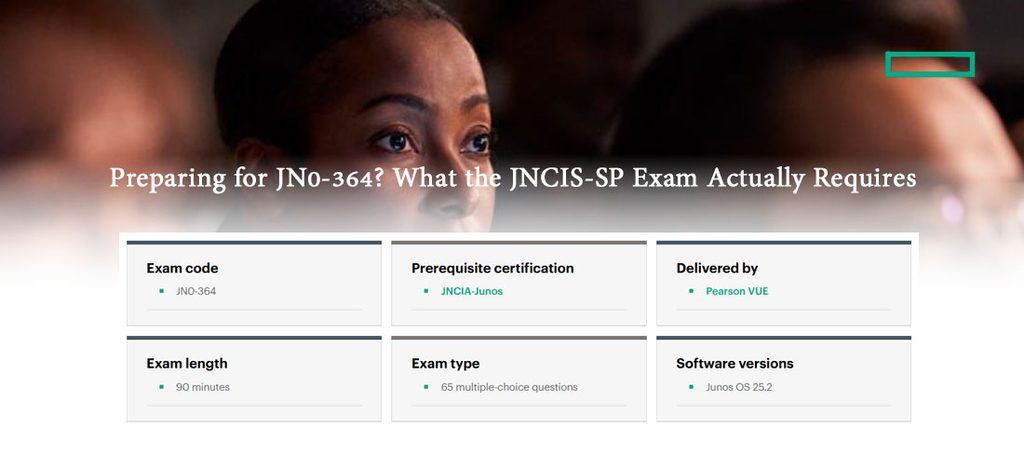
- Exam code: JN0-364
- Duration: 90 minutes
- Format: 65 multiple-choice questions
- Software version: Junos OS 25.2
- Language: English
- Prerequisite certification: JNCIA-Junos
The official JNCIS-SP certification page is the best starting point for checking the exam requirements and current objectives.
When preparing for the exam, candidates should learn to connect protocol behaviors with their specific implementations in Junos. For instance, understanding the definition of an OSPF adjacency is entirely different from being able to analyze why two Junos routers have failed to establish one. Similarly, mastering BGP attributes is only part of the task; candidates must also understand how routing policies and the route selection process influence what ultimately appears in the routing table.
Technical Areas You Need to Truly Understand for the JN0-364 Exam
The official exam objectives cover several interconnected areas. You should develop a deep understanding of how these technologies function, as well as the associated Junos operational tasks. Read on:
Routing Protocols: BGP, OSPF, and IS-IS
These protocols form a substantial part of the technical scope.
For BGP, candidates should understand its basic operation and message types, the purpose of attributes, and how the path-selection process works. They should also be comfortable distinguishing IBGP from EBGP and understanding how groups, peers, and routing policies affect route exchange.
A useful way to study BGP is to follow a route through the process: where it is learned, whether policy permits it, how it compares with other candidate routes, and whether it becomes active. Memorizing attribute definitions without understanding their effect on route selection leaves an important gap.
For OSPF, focus on the link-state database, packet types, router IDs, neighbors and adjacencies, DR/BDR roles, areas, router types, and LSA types. Candidates should be able to reason about adjacency formation and recognize which part of the process may be preventing routes from being learned.
For IS-IS, pay attention to its LSDB, protocol data units, TLVs, levels and areas, adjacencies, DIS election, and metrics. A useful comparison with OSPF is to understand how each protocol organizes and exchanges link-state information—not simply to memorize two separate lists of terminology.
The exam objectives also expect candidates to understand configuration, monitoring, and troubleshooting tasks for these routing protocols.
MPLS and Service Provider Forwarding
MPLS preparation should connect labels with actual packet forwarding.
Candidates should understand the MPLS header, label operations, the Label Information Base (LIB), and the relationship between MPLS and routing tables. They should also know the roles of LDP and RSVP in label distribution and how Label-Switched Paths (LSPs) are established and used.
Segment Routing with MPLS is also included in the objectives. Candidates should understand the basic forwarding idea and how shortest-path segment-routing LSPs fit into the service provider network.
The simplest and most effective way to test your understanding is to see if you can explain what happens to a data packet once it enters an MPLS path, how the associated label information is utilized, and—in the event that the intended forwarding path becomes unavailable—what steps you would take to troubleshoot the issue. Simply knowing the various acronyms is of little help when it comes to this kind of logical deduction.
Switching, IPv6, Tunnels, and High Availability
The remaining objectives are broad, but they are not simply optional background topics.
For Layer 2 bridging and VLANs, review bridging terminology, frame processing, virtual switches, port modes, tagging, Q-in-Q provider bridging, and Integrated Routing and Bridging (IRB). The spanning-tree objectives include STP, RSTP, MSTP, and VSTP, as well as port roles and states, BPDUs, convergence, and protection mechanisms.
IPv6 coverage includes static routes, dynamic routing through OSPFv3, IS-IS, and BGP, and IPv6 over IPv4 tunneling. The tunnel objectives specifically include GRE, its applications, and its configuration and troubleshooting.
High availability includes:
- Link Aggregation Groups (LAG)
- Graceful Restart (GR)
- Graceful Routing Engine Switchover (GRES)
- Nonstop Bridging (NSB)
- Nonstop Active Routing (NSR)
- Bidirectional Forwarding Detection (BFD)
- Virtual Router Redundancy Protocol (VRRP)
Candidates should be able to distinguish what these mechanisms protect, how they affect network continuity, and what configuration or operational evidence helps establish whether they are working as intended. The official objectives specify both conceptual knowledge and configuration, monitoring, or troubleshooting knowledge for several of these features.
Why Junos Configuration and Operational Output Matter
Reading about a protocol gives you a model of how it should work. Working with Junos helps you recognize what is actually happening on a device.
Consider a practical BGP situation: the peer is configured, but an expected route does not appear in the routing table. Knowing that the neighbor is configured correctly does not explain the missing route. You need to investigate the route’s path through the system.
A sensible troubleshooting sequence is:
- Check the peer state. Confirm whether the BGP session is established. If it is not, investigate the session before looking for a route that cannot yet be exchanged.
- Check route reception. Determine whether the peer is advertising the expected prefix and whether the local router has received it.
- Review import policy. A route can be received but rejected or modified by policy.
- Inspect route selection. If multiple candidate routes exist, understand why one is preferred over another.
- Check active route installation. A route being present in BGP does not automatically mean it becomes the active route in the routing table.
The value of this exercise is the reasoning sequence. Instead of jumping to a configuration change, you identify where the expected behavior stops.
The same approach applies to OSPF and IS-IS. Check the relevant interface and adjacency state, then examine the link-state information and routing results. Use operational evidence to narrow the problem instead of changing several settings at once.
Use Labs to Test What You Have Learned
Juniper’s vLabs platform provides pre-built topologies for exploring Juniper products and technologies. Users can sign in, choose a topology, and reserve a lab through its interface. It is a practical way to work with routing and switching scenarios without first assembling a physical network. Juniper Networks
For more structured study, Juniper lists three recommended courses for JNCIS-SP preparation:
- Junos Intermediate Routing
- Junos Service Provider Switching
- Junos MPLS Fundamentals
Juniper explicitly describes these as recommended training resources, not mandatory prerequisites. The exam prerequisite is JNCIA-Junos.
A lab session becomes more useful when you give it a specific task. Configure an adjacency, verify the resulting routes, change a policy, and observe what changes. Then introduce a controlled fault—such as disabling an interface or modifying a policy—and trace the effect. This builds a stronger connection between configuration, protocol behavior, and operational output than simply copying a working configuration.
Recent discussions in r/Juniper reflect a similar range of preparation experiences. In an August 2026 discussion, candidates described using the Juniper Learning Portal, vLabs, and additional hands-on practice; some specifically highlighted BGP, IS-IS, and MPLS as areas they spent time reviewing. A September discussion focused on rebuilding and deliberately breaking lab topologies to deepen practical understanding. These are individual experiences, not official exam guidance, but they reinforce the value of testing concepts rather than only watching or reading about them.
Build Your Study Plan Around Your Existing Experience
A useful JN0-364 study plan starts with what you already know. Candidates do not all begin from the same technical background, so spending equal time on every topic may be inefficient.
If you already have JNCIA-Junos, use that foundation to identify gaps in the specialist-level objectives. Pay particular attention to routing policy, BGP behavior, OSPF and IS-IS troubleshooting, MPLS forwarding, switching, and high availability. Do not assume that familiarity with basic Junos configuration means you are comfortable with every objective.
If your background is CCNA or another networking certification, your knowledge of IP routing, switching, and routing protocols is useful. The adjustment is learning how those concepts are configured and examined in Junos. Spend time with Junos configuration hierarchy, operational commands, routing policies, and the way Junos presents protocol and route information.
If you already work in a service provider environment, production experience can make many topics familiar. However, daily responsibilities may expose you to only part of the blueprint. An engineer who works mainly with BGP may still need a structured review of spanning tree, IPv6, GRE, or high-availability features.
Regardless of your background, use a repeatable process:
- Read the official JN0-364 objectives and mark each area as strong, uncertain, or unfamiliar.
- Study the concepts behind the uncertain areas.
- Use Junos documentation and training material to understand the relevant implementation.
- Test the behavior in a lab where practical.
- Use practice assessments to identify gaps, then return to the relevant topic.
The key is to spend more time on weaknesses than on subjects you can already explain and apply.
How to Tell Whether You’re Ready for JN0-364
Readiness is not established by finishing a course or reaching a particular score on one practice test. It is better judged across four areas.
Topic coverage: Can you explain the purpose and basic operation of the technologies listed in the official objectives? Can you identify where a feature fits into a service provider network?
Technical understanding: Can you explain why a route is selected, why a neighbor relationship forms or fails, or how a label-switched path forwards traffic? Your explanation should connect the configuration to the resulting behavior.
Troubleshooting ability: Can you interpret Junos operational information and use it to narrow down a fault? You should be able to explain what you would check next and why, rather than relying on guesswork.
Practice performance: Can you answer questions on different objective areas consistently, including topics you have not just reviewed? Can you explain why an answer is correct and why the alternatives are not?
When reviewing incorrect answers, classify the reason for the mistake. It may come from a missing concept, a misunderstanding of Junos behavior, confusion between similar technologies, or overlooking an important detail in the question. Each cause calls for a different kind of review.
Once you have grasped the learning objectives and covered the core Junos topics, using targeted practice resources can help you identify areas that still require further attention. If you are preparing for the JN0-364 exam, consider checking out our JN0-364 practice questions(https://www.leads4pass.com/jn0-364.html)—an excellent way to review exam-related content, assess your current level of understanding, and pinpoint specific topics that need more in-depth study. You can also choose between PDF or WebEngine formats, depending on your preferred learning style.
Is JNCIS-SP the Right Next Step for Your Networking Career?
JNCIS-SP is most directly relevant to engineers whose work involves service provider routing and switching, including environments where BGP, IGPs, MPLS, and provider switching are part of the network.
It can also provide a structured specialist-level goal for someone who has completed JNCIA-Junos and wants to develop further in the Service Provider track. Juniper lists JNCIP-SP as the next certification level in that track.
The certification is less directly aligned with someone whose primary interest is data center networking. Juniper has a separate Data Center certification path, with its own focus and course progression. That does not make JNCIS-SP irrelevant to every data center engineer, but the fit depends on the technologies used in the person’s role and the direction they want to develop.
The practical value comes from the skills you can apply. A certification can provide a structured way to study and demonstrate knowledge, but it does not replace experience operating networks, diagnosing faults, or making sound engineering decisions.
Preparing for JN0-364 With a Clear Focus
Use the current JN0-364 objectives to guide your preparation. Concentrate on the technologies you cannot yet explain or troubleshoot, and connect protocol knowledge to Junos configuration and operational evidence. Labs and practice questions can help reveal gaps, but the important step is understanding why a configuration or routing decision produces a particular result.
That is a more useful measure of preparation than simply counting the pages you have read or the questions you have completed.